
A powerful
advocacy campaign created for UN Women is gaining renewed global attention
after helping influence child marriage reform efforts in Pakistan through an
unusual but emotionally charged idea built around children’s wedding
invitations.
The
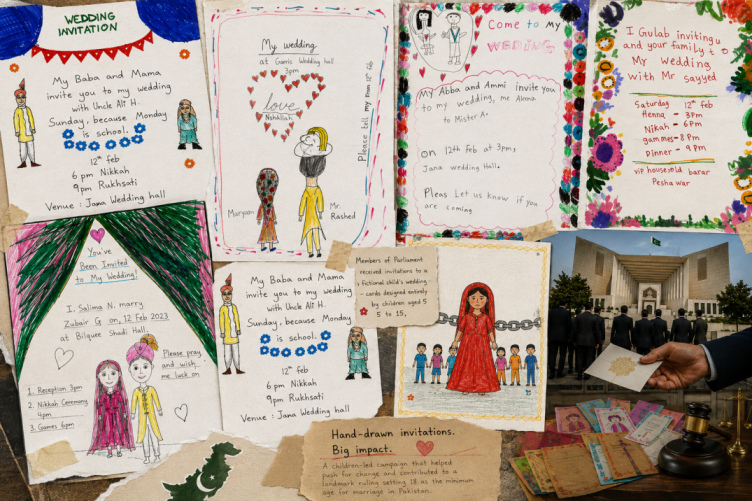
campaign, titled Child Wedding Cards, was developed by IMPACT BBDO Dubai
and used one of Pakistan’s most respected cultural traditions, wedding
invitation cards, to highlight the realities of child marriage.
Instead of
relying on celebrity endorsements or large-scale advertising campaigns, the
initiative focused on hand-delivered wedding cards designed by children aged
between five and fifteen, including contributions from a real former child
bride.
Each card
represented a different region of Pakistan and visually reflected the emotional
impact of child marriage through drawings, handwritten messages, and symbolic
storytelling.
The
invitations were delivered directly to members of parliament and political
leaders during discussions around child marriage legislation and legal reform
efforts.
The campaign
later became associated with growing political pressure surrounding the issue,
eventually contributing to a landmark directive from Pakistan’s Federal Islamic
Court setting 18 as the minimum legal age for marriage.
Campaign
Turned Cultural Symbol Into Political Message
The
initiative quickly attracted attention across advertising and advocacy
communities because of how effectively it transformed a familiar cultural
object into a political communication tool.
Wedding
invitations traditionally symbolize celebration and social acceptance within
South Asian culture. By redesigning those invitations from a child’s
perspective, the campaign forced lawmakers and the public to confront the
contradiction between cultural tradition and child marriage.
The
emotional weight of the cards became central to the campaign’s impact.
Rather than
depending heavily on statistics or formal political messaging, the initiative
used personal storytelling and visual symbolism to create a stronger emotional
response.
Reports
surrounding the campaign indicated that lawmakers carried the cards into
parliamentary discussions while debates around marriage laws intensified.
The campaign
also generated widespread media coverage and online discussion across Pakistan,
increasing public attention around child marriage and legal reform.
Advertising
Industry Sees New Model for Social Impact
The success
of Child Wedding Cards is also being viewed as an example of how modern
advertising campaigns can influence public discourse beyond commercial
branding.
Unlike
traditional campaigns driven by large budgets and broad media buying, the
project relied on cultural insight, emotional storytelling, and targeted
delivery.
The
campaign’s simplicity became one of its strongest elements.
There were
no massive digital activations or expensive celebrity campaigns attached to the
initiative. Instead, the idea focused entirely on delivering one emotionally
powerful message directly into political spaces where legal decisions were
being discussed.
The
involvement of children, including a former child bride, added authenticity
that strengthened public engagement around the campaign.
The initiative is now being recognized across creative and advocacy industries as an example of how culturally grounded storytelling can influence legal conversations, public awareness, and social change more effectively than traditional awareness campaigns alone.


.jpg)


Comments
Loading comments...
Leave a Comment