
.jpg)
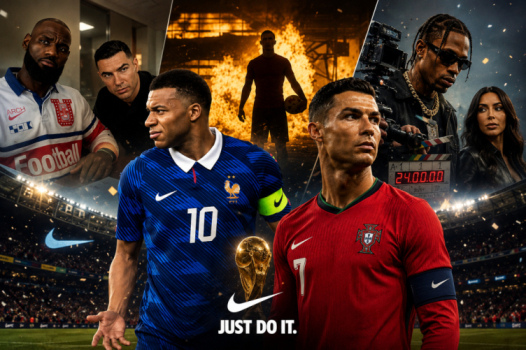
Nike has launched an ambitious 12-week global marketing campaign titled Universe of Football, assembling some of the world’s biggest names across sports, music, fashion, and internet culture ahead of the 2026 FIFA World Cup.
The campaign
features a high-profile lineup including Cristiano Ronaldo, Kylian Mbappe,
Erling Haaland, Travis Scott, Kim Kardashian, Central Cee, and Ronaldinho among
others, combining football culture with entertainment, celebrity influence,
fashion, and social media virality.
Nike
revealed the campaign through a stylized Polaroid-inspired rollout featuring
cinematic portraits, retro visual aesthetics, and short-form social content
designed for heavy engagement across Instagram, TikTok, YouTube, and X.
The campaign
marks one of Nike’s biggest football-focused branding pushes in recent years as
competition intensifies across the global sportswear market ahead of the 2026
FIFA World Cup.
Nike
Expands Beyond Football Into Culture Driven Marketing
The Universe
of Football campaign reflects a growing shift in modern sports marketing
where brands are no longer promoting sports alone, they are building cultural
ecosystems around athletes, creators, musicians, fashion icons, and online
communities.
Instead of
relying solely on match performance or tournament sponsorships, Nike is
positioning football as a lifestyle and entertainment experience designed to
dominate conversation both on and off the pitch.
The
inclusion of figures such as Travis Scott and Kim Kardashian signals how sports
brands increasingly depend on crossover audiences and internet culture to
maximize visibility among younger consumers.
The campaign
also demonstrates how celebrity influence is evolving inside marketing.
Athletes are
no longer functioning only as endorsers. They are now part of broader content
ecosystems where fashion, music, social media presence, and personal branding
contribute equally to campaign impact.
Nike’s
rollout strategy appears heavily optimized for modern algorithm-driven
platforms, with visually stylized content designed for repostability, meme
culture, reaction edits, and viral short-form engagement.
The
Polaroid-style reveal aesthetic also taps into a growing nostalgia-driven
branding trend currently dominating fashion, sportswear, and entertainment
marketing campaigns globally.
FIFA
World Cup Becoming a Massive Branding Battleground
The 2026
FIFA World Cup is already shaping up to become one of the largest marketing
events in modern sports history, with global brands aggressively competing for
audience attention months before the tournament begins.
For Nike,
the Universe of Football campaign is not simply about promoting football
products, it is about controlling cultural relevance during one of the world’s
biggest media moments.
The campaign
reflects how sportswear companies increasingly measure success through online
engagement, creator participation, and cultural visibility rather than
traditional advertising impressions alone.
Social media
conversation surrounding the campaign accelerated almost immediately after
launch, with fans sharing reactions, edits, screenshots, and celebrity
appearances across multiple platforms.
The scale of
the campaign also highlights how major brands are investing heavily into
personality-driven marketing, where audiences connect more strongly with
recognizable figures and internet culture than traditional promotional
messaging.
As the countdown to the 2026 FIFA World Cup continues, Nike’s latest rollout demonstrates how global sports marketing is evolving into a fusion of entertainment, fashion, celebrity culture, and algorithm-driven digital storytelling designed to dominate attention far beyond the football field itself.

Comments
Loading comments...
Leave a Comment