
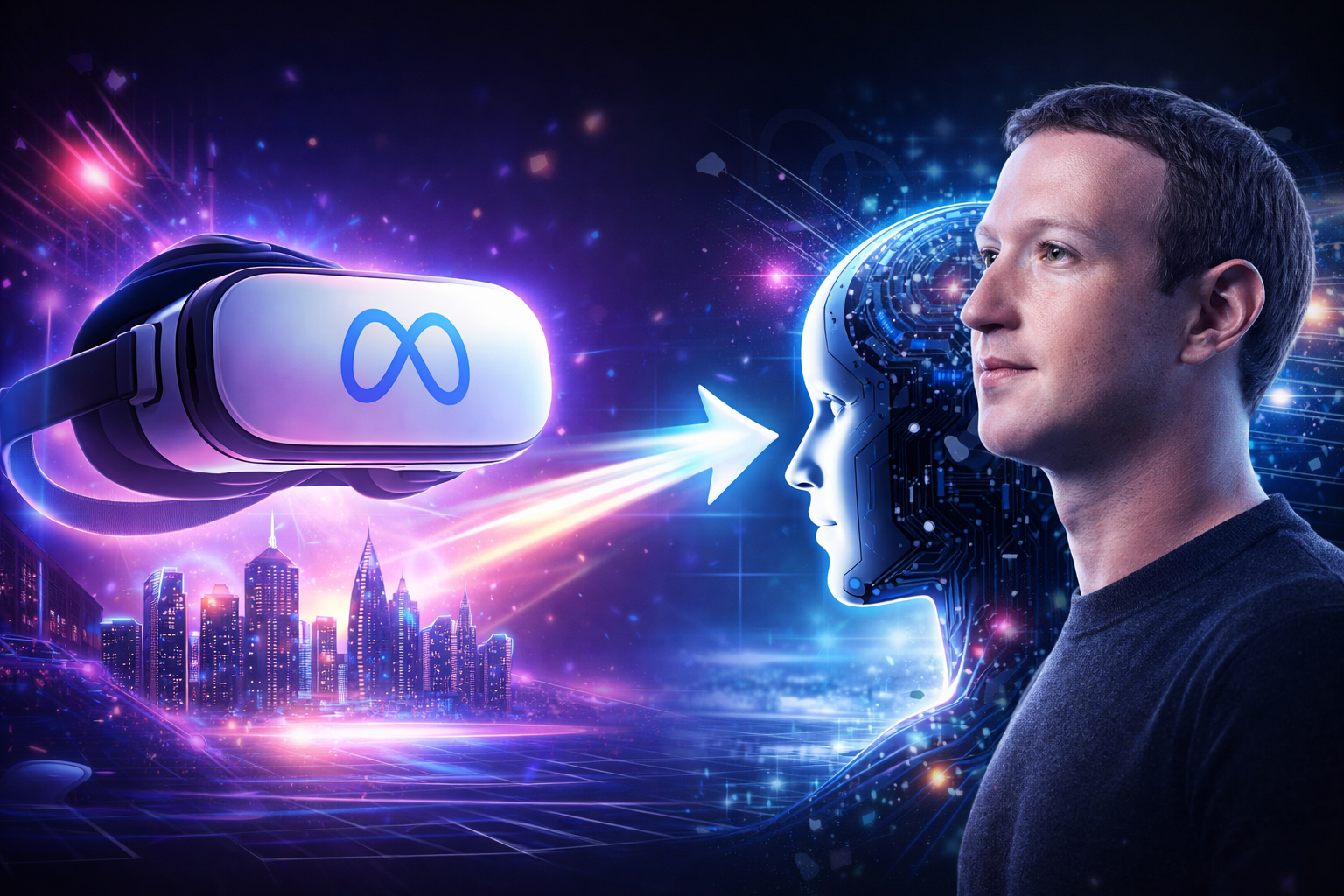
Meta
Platforms is significantly scaling back its metaverse ambitions after years of
heavy investment, marking a major strategic shift in one of the most closely
watched experiments in the technology industry.
The move
follows mounting evidence that Meta’s virtual reality ecosystem, once
positioned as the future of digital interaction, has struggled to gain
widespread adoption. The company is now reducing focus on its flagship
metaverse platform, Horizon Worlds, while redirecting resources toward
artificial intelligence and other emerging technologies.
Horizon
Worlds Scaled Back on VR Platforms
At the
center of Meta’s metaverse strategy was Horizon Worlds, a virtual social
platform designed to allow users to interact in immersive 3D environments using
VR headsets.
Recent
announcements indicate that Meta is ending or significantly reducing support
for Horizon Worlds on VR devices, with key changes set to take effect in
2026. The platform will no longer support new VR content development and is
being shifted toward a mobile-first experience, reflecting changing user
behavior.
Reports also
indicate that Horizon Worlds will be removed from the Quest Store and that
VR-based experiences will be limited or discontinued by mid-2026, effectively
ending its role as a central VR social platform.
While Meta
has not formally declared the “end” of the metaverse, the decision represents a
clear retreat from its earlier vision of a fully immersive virtual ecosystem.
Billions
Invested, Limited Adoption
Meta’s pivot
comes after years of massive investment in virtual reality and metaverse
technologies.
Since
rebranding from Facebook in 2021, the company has invested tens of billions
of dollars into its Reality Labs division, which oversees VR hardware,
software, and metaverse initiatives. Industry estimates suggest total spending
has exceeded $80 billion, making it one of the most expensive bets in
tech history.
Despite this
investment, user adoption has remained limited.
Internal and
external reports have repeatedly highlighted low engagement levels within
Horizon Worlds, with many virtual spaces seeing minimal user activity.
Analysts say
the gap between Meta’s ambitious vision and actual consumer demand played a
critical role in the company’s decision to scale back.
Shift
Toward Artificial Intelligence
Meta’s
strategic pivot is closely tied to the broader industry shift toward artificial
intelligence.
The company
has been increasing investments in AI infrastructure, talent, and product
development, positioning itself to compete with other major players in
generative AI.
Recent
restructuring efforts, including reported layoffs and budget reallocations,
reflect this transition away from metaverse-focused spending and toward
AI-driven initiatives.
Executives
have indicated that AI is now a central priority, with applications ranging
from content generation to personalized user experiences across Meta’s
platforms.
VR
Strategy Moves to Gaming and Mobile
Rather than
abandoning VR entirely, Meta appears to be redefining its approach.
The company
is shifting its VR ecosystem away from a metaverse-first model and toward a gaming-focused
platform, which has shown stronger user engagement.
Data from
recent reports suggests that VR gaming titles on Meta’s Quest platform have
achieved significantly higher traction than social metaverse experiences, with
several games generating substantial revenue.
At the same
time, Meta is prioritizing mobile accessibility for Horizon Worlds, aiming to
reach a broader audience without requiring specialized hardware.
This dual
strategy,gaming in VR and social experiences on mobile,marks a departure from
the original vision of a unified immersive metaverse.
Additional
Metaverse Projects Discontinued
Meta’s
scaling back of metaverse ambitions extends beyond Horizon Worlds.
Earlier in
2026, the company shut down Horizon Workrooms, a virtual reality
collaboration tool designed for remote work environments.
The closure
reflects broader challenges in translating metaverse concepts into practical
business applications.
Other
initiatives within Meta’s Reality Labs division have also been reduced or
discontinued, as the company reassesses its long-term strategy.
Industry
Reaction and Broader Implications
Meta’s
retreat from its metaverse vision has sparked significant discussion within the
technology industry.
When CEO
Mark Zuckerberg first introduced the metaverse concept as the company’s future,
it was widely seen as a transformative shift in how people would interact
online.
However, the
reality has been more complex.
High costs,
limited user adoption, and technical barriers,including expensive VR hardware
and usability challenges,have slowed the growth of metaverse platforms.
Industry
observers say Meta’s decision highlights a broader trend: consumer demand
ultimately determines the success of new technologies, regardless of
investment scale.
The shift
also underscores how quickly priorities can change in the tech sector, where
emerging technologies like AI can rapidly overtake earlier innovations.
Not the
End, but a Repositioning
Despite
scaling back, Meta has not completely abandoned the metaverse concept.
The company
continues to invest in related technologies, including augmented reality, smart
glasses, and mixed-reality devices.
Horizon
Worlds itself is expected to continue in a limited form, particularly on mobile
platforms, suggesting that Meta still sees potential in virtual environments,albeit
in a different format.
Some
analysts argue that the metaverse is evolving rather than disappearing, with
elements of the concept being integrated into gaming, social media, and
AI-driven experiences.
Outlook
Meta’s
decision to scale back its metaverse ambitions marks a turning point in one of
the most ambitious projects in recent technology history.
The
company’s renewed focus on artificial intelligence reflects broader industry
trends, as tech giants race to develop advanced AI systems capable of reshaping
digital interactions.
For Meta,
the challenge now lies in balancing its long-term vision with practical user
demand, an issue that ultimately defined the trajectory of its metaverse
initiative.
While the
original vision of a fully immersive virtual world has yet to materialize, the
technologies developed during this period may still influence future
innovations across gaming, social media, and digital communication.
For now, Meta’s pivot signals a clear message: in the fast-moving technology landscape, even the boldest ideas must adapt to reality.

.jpg)

Comments
Loading comments...
Leave a Comment