
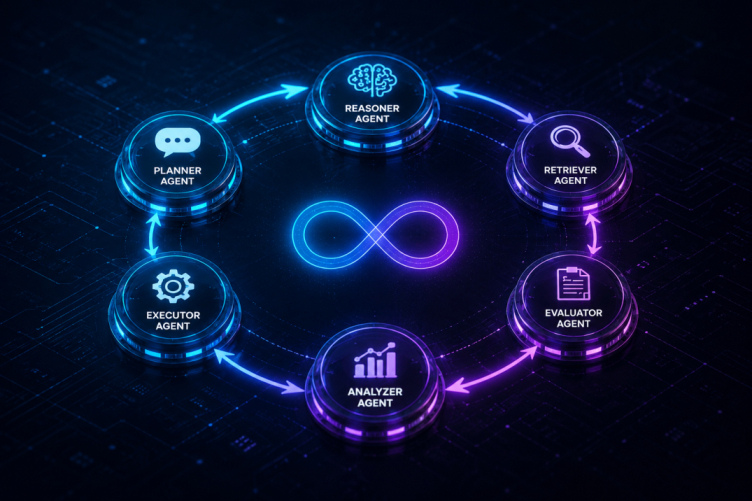
A new approach to artificial intelligence development known as "loop engineering" is gaining traction across the technology industry, enabling AI systems to handle increasingly complex tasks with minimal human intervention.
The technique relies on structured cycles of execution, evaluation and correction, allowing AI agents to repeatedly review and improve their own work before delivering a final result. Supporters of the approach believe it could significantly expand the capabilities of AI systems in areas such as software development, research, data analysis and business operations.
Unlike traditional prompting methods, where users provide instructions and receive a single response, loop engineering introduces continuous feedback mechanisms. AI agents are assigned tasks, evaluate their outputs, identify mistakes and rerun processes until predefined quality standards are met.
The concept has attracted attention from engineers and researchers working at the forefront of artificial intelligence development. Many believe the approach represents a major step toward creating more reliable autonomous AI systems capable of completing multi-stage projects without constant human supervision.
One of the most visible applications has emerged in software engineering. Developers are increasingly using AI loops to write, review, test and refine code automatically. Instead of generating a single code snippet, AI agents can now produce code, verify functionality, identify errors and generate improved versions through multiple iterations.
The growing adoption of the technique is already producing measurable results inside technology organizations. Engineers report that loop-based systems are helping accelerate software development workflows by reducing the amount of manual intervention required during coding and debugging processes.
The approach is also finding applications beyond software development. Researchers are experimenting with AI loops for large-scale data analysis, market research and information verification. By combining multiple AI models with different responsibilities, organizations can create systems where one model performs a task while another independently reviews and validates the results.
A recent demonstration highlighted the potential of this method when AI agents were tasked with analyzing information related to one hundred electric vehicle companies. The system completed the research through multiple verification cycles, identifying and correcting inconsistencies before producing a final report. The example showcased how iterative review processes can improve accuracy while reducing the likelihood of errors.
Advocates argue that loop engineering changes the role of humans in AI-driven workflows. Rather than spending time crafting detailed prompts for every individual task, users can focus on defining objectives, setting constraints and evaluating final outputs. The AI system then handles much of the intermediate work independently.
The trend reflects a broader shift within the artificial intelligence industry toward autonomous agents capable of planning, executing and refining tasks without continuous oversight. As AI models become more powerful, developers are increasingly focused on designing systems that can manage longer and more complex workflows.
Despite the enthusiasm surrounding loop engineering, challenges remain. Running multiple execution and verification cycles can increase computational requirements and operating costs. Organizations must also implement safeguards to prevent AI systems from reinforcing mistakes or producing inaccurate conclusions through repeated iterations.
Reliability, transparency and oversight continue to be key concerns as autonomous AI systems become more capable. Developers are exploring methods to ensure that loop-based agents remain aligned with user objectives while maintaining accuracy and accountability.
The rise of loop engineering reflects the industry's push toward more autonomous AI systems that can manage multi-step tasks with less human involvement. By enabling AI systems to repeatedly improve their own outputs, the approach is pushing automation beyond simple task completion and toward more sophisticated problem-solving capabilities.
As adoption expands, loop engineering could play a significant role in shaping the next generation of AI-powered tools, changing how organizations approach coding, research and complex decision-making in the years ahead.

.jpg)

Comments
Loading comments...
Leave a Comment