
Anthropic's
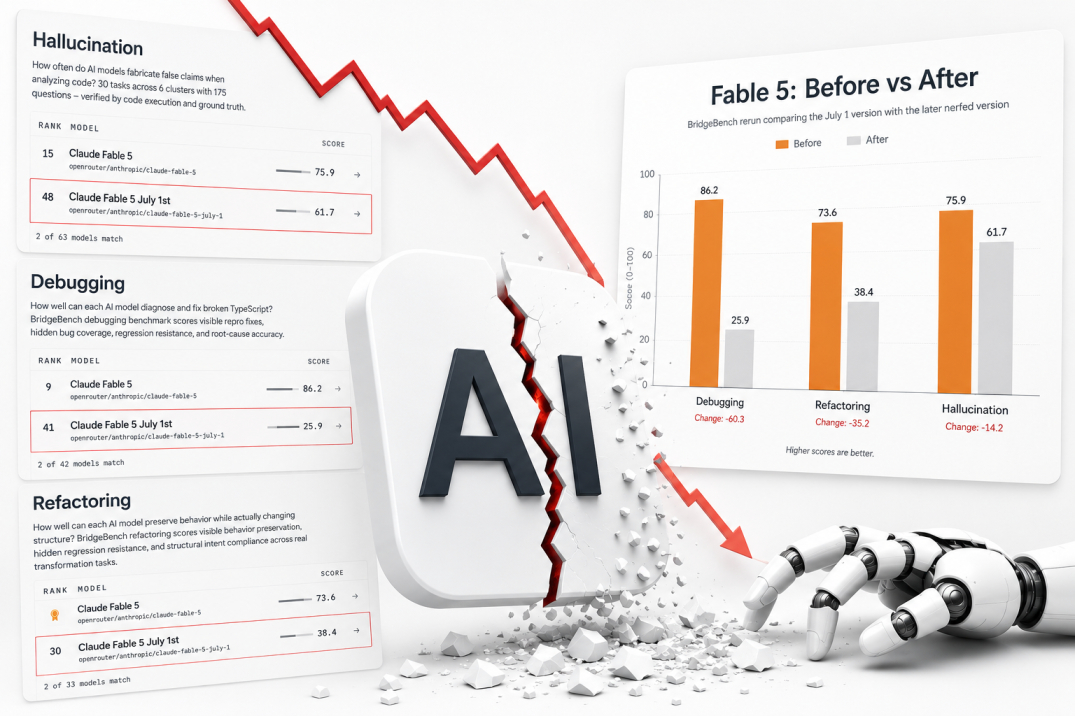
latest Fable 5 AI model has come under scrutiny after new benchmark results
indicated a noticeable decline in coding performance following the deployment
of an updated safety classifier. The changes have prompted discussions among
developers, with many reporting that the model has become more restrictive when
handling programming-related requests.
According to
recent BridgeBench evaluation results, Fable 5 recorded substantially lower
scores across several coding categories after the safety update was introduced.
Debugging performance showed one of the largest declines, while refactoring and
hallucination-handling capabilities also registered lower benchmark results
compared with earlier evaluations.
The
performance shift has been linked to a stricter safety filtering system rather
than modifications to the core language model itself. The updated classifier is
designed to identify and block requests that could potentially be misused, but
developers say it is also rejecting a wider range of legitimate programming
tasks.
Several
users have reported that coding prompts previously handled without difficulty
are now being declined or redirected, particularly when requests involve
debugging, code modification or security-related programming. The increased
filtering has reportedly affected complex development workflows that require
detailed technical assistance.
Anthropic
has introduced the revised safety layer as part of its ongoing efforts to
strengthen safeguards around advanced AI systems. Instead of processing certain
requests directly, the classifier evaluates prompts before they reach the
model, preventing responses to queries considered potentially risky.
For requests
flagged by the new system, users may instead be routed to Opus 4.8, another
model within Anthropic's AI portfolio that is intended to manage specific
categories of work under different operational settings.
The
benchmark results have fueled broader conversations about the balance between
AI safety and practical usability. As AI coding assistants become more capable,
developers are increasingly relying on them for software engineering, debugging
and code reviews. More restrictive safety controls, while intended to reduce
misuse, can also limit the usefulness of these systems for legitimate
professional tasks.
Developers
participating in community discussions have largely attributed the recent
performance decline to the updated safety classifier rather than any reduction
in the underlying capabilities of Fable 5 itself. Many believe the model's
reasoning and coding abilities remain intact, with the stricter filtering
affecting what users are allowed to access.
The
development highlights a growing challenge for AI companies as they continue
refining powerful language models. Balancing strong safety protections with
consistent performance has become a key priority, particularly as enterprise
customers increasingly depend on AI tools for day-to-day software development.
While
Anthropic has not announced further changes to the deployment, the latest
benchmark results have renewed debate over how safety systems should be
implemented without significantly impacting productivity for developers using
advanced AI coding assistants.

.jpg)

Comments
Loading comments...
Leave a Comment