
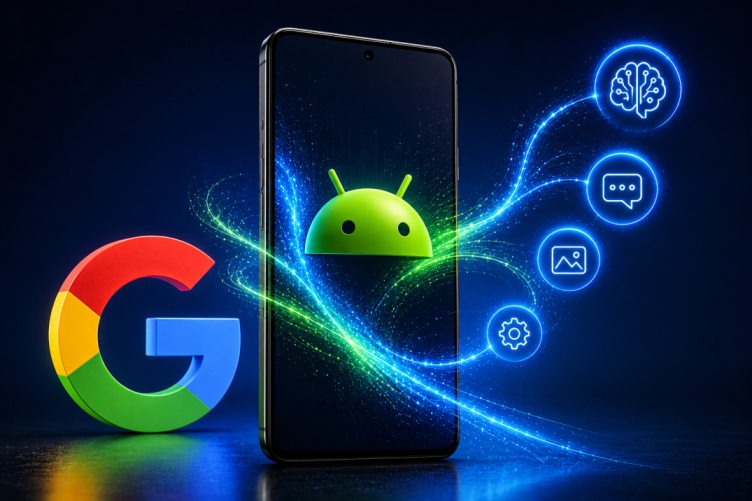
Google is
accelerating its push toward an “AI first smartphone” future through deeper
integration of Gemini across Android devices, signaling a major shift in how
smartphones are expected to function in the coming years.
The
company’s latest Gemini expansion reflects Google’s broader strategy to
transform smartphones from traditional app driven devices into proactive AI
powered assistants capable of handling tasks, understanding context, and
interacting more naturally with users throughout the day.
Rather than
positioning Gemini as a standalone chatbot, Google is embedding the AI system
directly into the core smartphone experience across search, communication,
productivity, navigation, and device interaction.
The move
comes as competition intensifies between major technology companies racing to
define the next era of AI powered consumer hardware.
Google
executives increasingly describe smartphones as evolving into intelligent
systems capable of anticipating needs, organizing workflows, summarizing
information, generating content, and performing multi step actions with minimal
manual input.
Gemini is
now being integrated across several Android experiences, including messaging,
camera tools, search features, notifications, voice interactions, and
contextual assistance. The company is also expanding Gemini’s ability to
understand on screen content and respond dynamically based on what users are
currently viewing or doing on their devices.
The shift
represents one of the biggest transformations in smartphone software since the
rise of app ecosystems more than a decade ago.
For years,
smartphones largely depended on users manually opening apps, switching
interfaces, and navigating menus to complete tasks. Google’s AI first strategy
aims to reduce that friction by allowing Gemini to function as an intelligent
layer operating continuously across the device.
The
company’s long term vision appears focused on turning smartphones into always
available AI companions rather than simple communication tools.
AI
Becoming the Center of Smartphone Competition
Google’s
aggressive Gemini rollout also reflects how artificial intelligence is rapidly
becoming the primary battleground inside the global smartphone industry.
Instead of
competing only on camera quality, processor speed, or display upgrades,
technology companies are increasingly using AI capabilities as the central
selling point for new devices and software ecosystems.
The rise of
AI powered smartphones is already reshaping product strategies across the
industry.
Companies
including Apple, Samsung, Microsoft, and Chinese smartphone manufacturers are
investing heavily into on device AI systems, real time assistants, generative
AI features, and intelligent operating system experiences.
Google,
however, is attempting to position Gemini as a fully integrated ecosystem
rather than a collection of isolated AI tools.
The
company’s AI first smartphone strategy also aligns closely with broader changes
happening across consumer technology, where users increasingly expect devices
to automate repetitive actions, personalize experiences, and respond
conversationally.
At the same
time, the growing expansion of AI into smartphones is raising larger industry
discussions around privacy, data access, device dependency, and how much
control AI systems should have inside everyday digital experiences.
Despite
those concerns, Google’s latest Gemini push makes one thing increasingly clear:
the smartphone industry is entering a new phase where artificial intelligence
may soon become the primary interface between users and their devices.
For Google,
the race is no longer just about building better smartphones.
It is about building phones that think, respond, organize, and assist continuously in real time, turning AI itself into the operating system experience.

.jpg)

Comments
Loading comments...
Leave a Comment