
Apple has
thrown a spotlight on the limits of today’s most advanced artificial
intelligence systems, publishing research that questions whether so-called
“reasoning” models truly scale beyond pattern recognition when confronted with
complex problems.
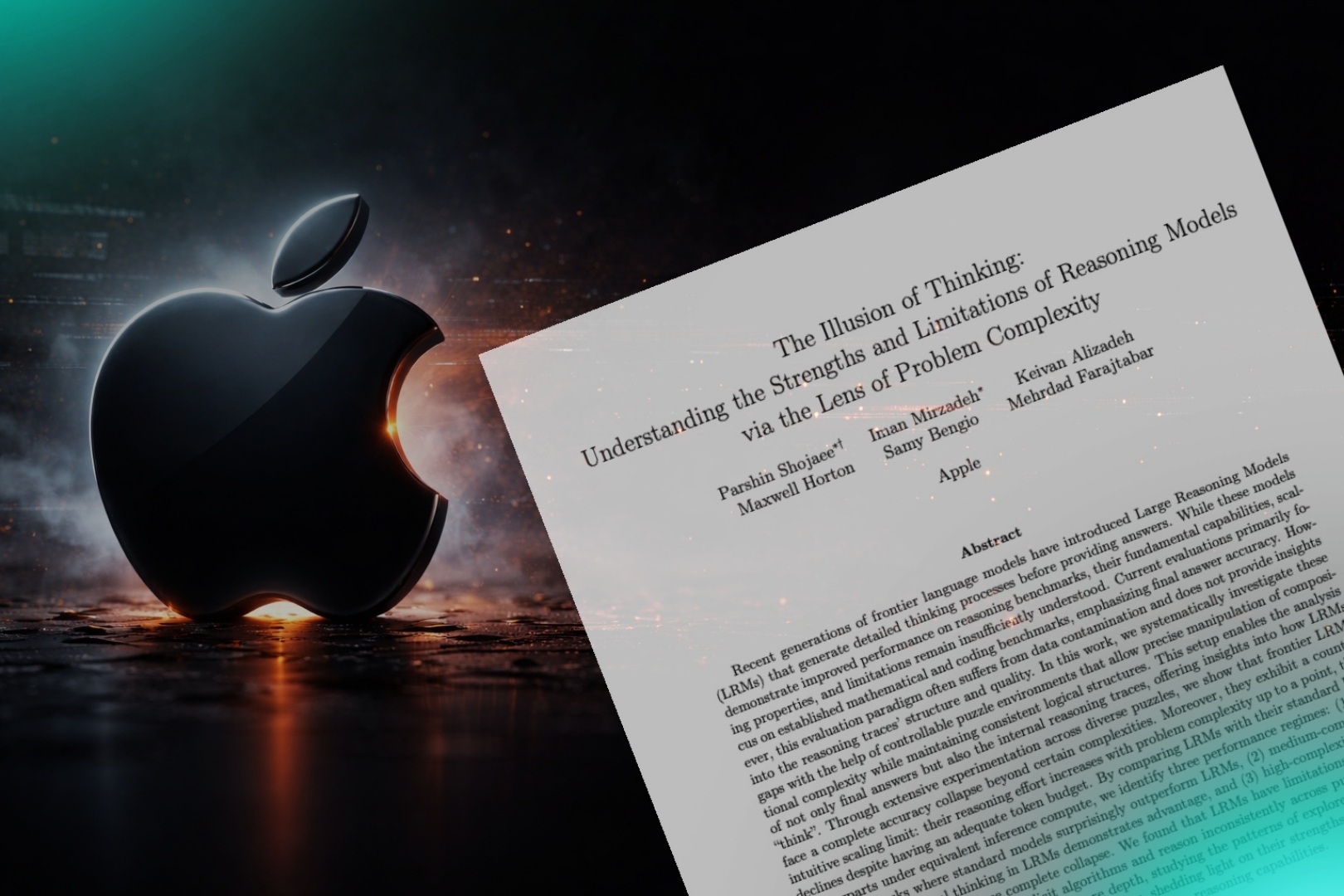
In a June
2025 paper titled The Illusion of Thinking: Understanding the Strengths and
Limitations of Reasoning Models via the Lens of Problem Complexity, Apple’s
machine learning team examined how Large Reasoning Models (LRMs) perform as
task difficulty increases. The findings suggest that while these models can
outperform standard large language models on moderately complex challenges,
they struggle sharply, and sometimes collapse entirely, when complexity crosses
a certain threshold.
The paper
directly engages with industry claims that reasoning-oriented AI systems
represent a major step toward human-like intelligence.
Testing
the Limits of “Reasoning” AI
Large
Reasoning Models are designed to generate step-by-step internal logic before
producing final answers, a process commonly referred to as “chain-of-thought
reasoning.” Developers argue that this structured approach allows models to
tackle more sophisticated analytical tasks compared to traditional large
language models that generate responses directly.
To test that
assumption, Apple researchers built controlled puzzle environments where
problem complexity could be systematically increased. This allowed them to
measure how both reasoning models and standard models behaved across simple,
moderate, and high-difficulty tasks.
Across
multiple experiments, researchers observed a consistent three-phase pattern:
- Low complexity: Standard language models
frequently matched or outperformed reasoning models.
- Moderate complexity: Reasoning models showed
measurable advantages.
- High complexity: Both model types experienced
sharp accuracy breakdowns, with performance deteriorating rapidly as
difficulty increased.
In some high-complexity settings, accuracy fell close to zero, despite models still having available computational budget to continue generating responses.
When
Scaling Effort Doesn’t Scale Results
One of the
most notable findings was that reasoning models appeared to increase their
intermediate reasoning steps as tasks became harder, but this additional effort
did not translate into sustained accuracy gains.
Researchers
described what amounts to a scaling ceiling: beyond a certain point,
performance did not gradually degrade but instead dropped abruptly. This
contradicts expectations that allocating more computation to structured
reasoning would proportionally improve outcomes.
In classic
planning problems such as Tower of Hanoi, where required steps grow
exponentially with difficulty, models failed to consistently apply known
algorithmic strategies. Instead, their responses suggested reliance on pattern
approximation rather than systematic logic execution.
The research
raises a core question: are current reasoning models performing structured
thought, or are they simulating reasoning patterns without true algorithmic
depth?
Industry
Reaction and Debate
Apple’s
findings have sparked debate within the AI research community.
Some
analysts view the paper as an important corrective to growing hype around
reasoning-based systems. They argue that benchmark improvements may overstate
progress toward generalizable reasoning, particularly when tasks extend beyond
training distributions.
Others
contend that the observed performance limits may reflect experimental framing
rather than fundamental model weaknesses. Critics suggest alternative
evaluation setups, adjusted token limits, or different task formulations could
yield stronger results.
The debate
underscores a persistent challenge in AI evaluation: distinguishing genuine
reasoning capability from advanced statistical pattern matching.
Implications
for Commercial AI and AGI Narratives
The timing
of the research is significant. AI developers have increasingly positioned
reasoning models as stepping stones toward artificial general intelligence
(AGI), systems capable of flexible, human-like problem solving across domains.
Apple’s
analysis does not dismiss the utility of reasoning models. Instead, it
emphasizes that improvements appear constrained within specific complexity
bands. When pushed beyond moderate difficulty, performance may not scale
reliably.
For
enterprises deploying AI in high-stakes decision-making environments, this
suggests that human oversight and hybrid architectures remain critical.
Structured reasoning outputs may enhance interpretability, but they do not
guarantee robustness under escalating complexity.
The findings
also highlight a broader industry inflection point: as foundational models
mature, competitive differentiation may hinge less on benchmark gains and more
on reliability under real-world stress conditions.
A Reality
Check on AI Capabilities
Importantly,
the paper does not claim that AI progress has stalled. Nor does it argue that
reasoning models lack value. Instead, it provides empirical evidence that
current architectures may face intrinsic scaling constraints when tasked with
deeply recursive or combinatorially explosive problems.
For
investors, researchers, and policymakers tracking AI’s trajectory, the message
is clear: visible step-by-step explanations should not automatically be equated
with scalable reasoning competence.
What
Comes Next
The
discussion sparked by Apple’s research is likely to intensify as model
developers refine architectures and training strategies aimed at improving
logical depth. Future work may explore hybrid symbolic-neural systems, new
evaluation benchmarks, or alternative scaling approaches designed to overcome
the observed ceilings.
For now,
Apple’s study serves as a measured but impactful contribution to the AI
capability debate, reminding the industry that fluency and structured output do
not necessarily equal human-like reasoning at scale.
As
competition accelerates in the race toward more powerful AI systems,
understanding where models break down may prove just as important as
celebrating where they excel.

.jpg)


Comments
Loading comments...
Leave a Comment