
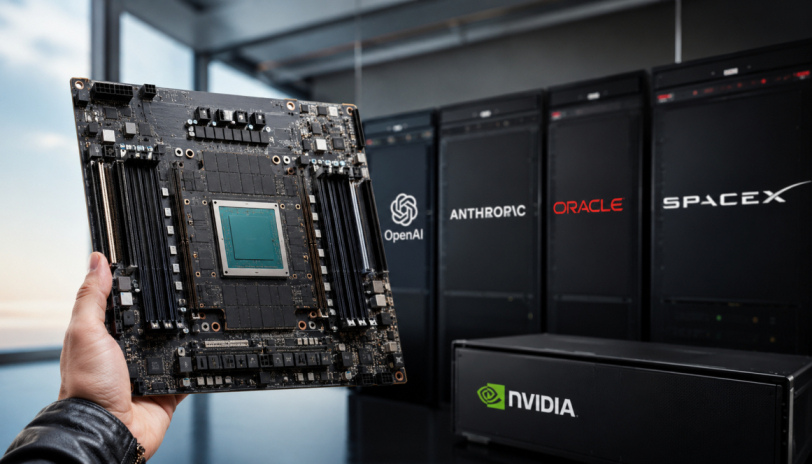
NVIDIA has
started delivering its first Vera CPUs to major artificial intelligence
companies including OpenAI, Anthropic, Oracle, and SpaceX, marking a major
expansion of the company’s AI infrastructure strategy beyond GPUs.
The rollout
represents NVIDIA’s latest move to strengthen its position at the center of the
global AI computing race as demand for high-performance infrastructure
continues accelerating across the industry.
The Vera
processor is designed specifically for advanced AI workloads and large-scale
“agentic AI” systems capable of performing autonomous tasks such as coding,
simulations, reasoning, and workflow execution.
The
processor reportedly includes 88 Arm-based CPU cores combined with
high-bandwidth memory architecture optimized for AI computing environments and
next-generation AI factories.
The first
units were personally delivered by NVIDIA Vice President Ian Buck, who publicly
showcased one of the early Vera motherboards before shipment. Elon Musk later
reacted to the processor on X after examining the hardware.
The early
shipments to OpenAI, Anthropic, Oracle, and SpaceX highlight the growing
competition among AI companies to secure specialized infrastructure capable of
supporting increasingly advanced AI systems.
NVIDIA
Expands AI Infrastructure Beyond GPUs
NVIDIA has
traditionally dominated the artificial intelligence hardware market through its
GPUs, which power many of the world’s largest AI systems and cloud
infrastructure networks.
With Vera,
the company is now moving aggressively into integrated AI computing platforms
that combine CPUs, GPUs, networking systems, memory infrastructure, and
software ecosystems into unified AI environments.
The launch
also reflects the rapidly growing importance of “AI factories”, large-scale
computing facilities dedicated to training and operating advanced AI models
requiring enormous processing power and continuous computational workloads.
Vera CPUs
are expected to work alongside NVIDIA’s upcoming Rubin GPU systems to improve
performance and efficiency inside these AI environments.
The use of
Arm-based architecture also reflects broader changes in the semiconductor
industry, where energy-efficient computing systems are becoming increasingly
important for cloud infrastructure and AI operations.
As
competition intensifies across the AI hardware market, companies including AMD,
Intel, Google, Amazon, and Microsoft are continuing to invest heavily in custom
AI chips and infrastructure technologies.
Despite
growing competition, NVIDIA remains the dominant force in AI hardware due to
its GPU ecosystem, AI software frameworks, and expanding data center
infrastructure business.
AI
Infrastructure Race Continues to Accelerate
The shipment
of Vera CPUs highlights how rapidly the AI infrastructure race is expanding as
companies push toward more advanced autonomous AI systems.
AI
developers are increasingly demanding specialized processors capable of
handling continuous reasoning, large-scale simulations, autonomous
decision-making, and multi-step AI operations.
The rapid
growth of generative AI, enterprise AI systems, scientific computing, and
autonomous agents is also driving massive investment into next-generation
infrastructure.
For NVIDIA,
Vera represents more than a processor launch. The rollout signals the company’s
broader ambition to control larger portions of the AI computing stack as
artificial intelligence becomes one of the most important technology sectors
globally.
The
increasing demand for integrated AI infrastructure is expected to fuel further
competition across the semiconductor industry as companies race to build
faster, more efficient, and more scalable computing systems for the future of
AI.

.jpg)


Comments
Loading comments...
Leave a Comment