
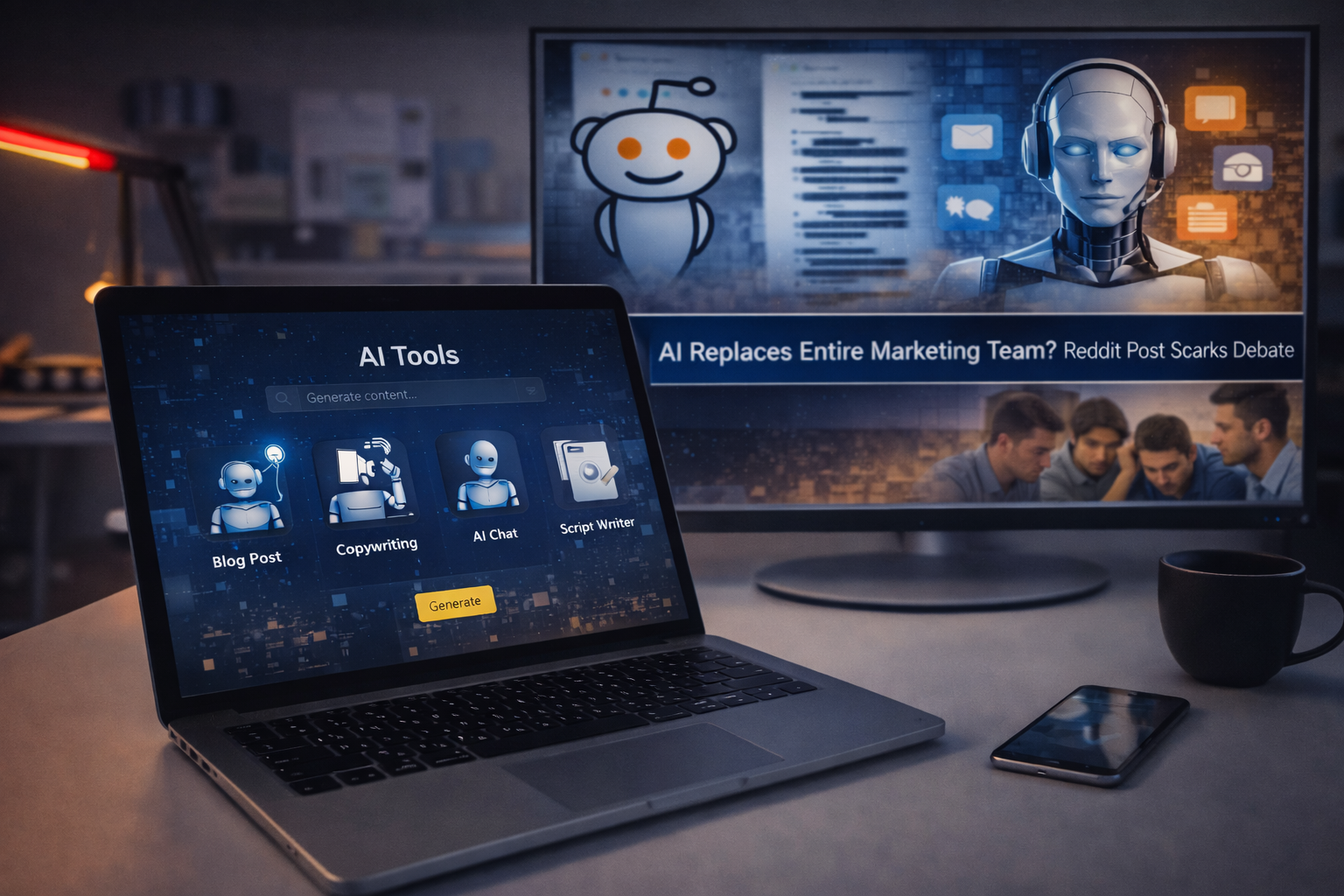
A viral
Reddit post claiming that a business owner replaced his entire marketing team
with artificial intelligence tools has ignited widespread debate across the
digital marketing industry this week.
The post,
shared in a popular entrepreneurship forum, rapidly gained traction, drawing
thousands of upvotes and comments within hours. In the thread, the user claimed
that roles traditionally handled by content writers, social media managers,
paid advertising specialists, and junior analysts were replaced with a suite of
generative AI platforms.
According to
the post, tasks such as blog writing, ad copy creation, campaign planning,
email marketing, and performance reporting were fully automated. The business
owner described the shift as “faster and leaner,” stating that workflows were
streamlined and operational costs were reduced significantly.
However, the
post did not provide detailed metrics to support claims of improved
performance, leaving many industry professionals questioning whether efficiency
translated into measurable growth.
Sharp
Divide Within the Marketing Community
Reactions
were immediate and polarized.
Supporters
argued that automation is an inevitable progression in modern business. With AI
tools capable of generating content at scale and analyzing campaign data in
real time, some entrepreneurs believe traditional marketing team structures may
be outdated.
“Technology
replaces inefficiency,” one commenter wrote, echoing a sentiment shared by
several business owners in the thread.
Critics,
however, warned against oversimplifying the role of marketing teams. While AI
can assist in execution, they argued, it cannot independently manage brand
positioning, audience psychology, emotional storytelling, or long-term
strategic direction.
“Marketing
is not just production,” one strategist commented. “It’s perception, trust, and
consistency.”
Efficiency vs Long-Term Impact
The debate
has highlighted a critical distinction between cost reduction and competitive
advantage.
Automation
may reduce payroll expenses and increase output volume. But long-term brand
equity depends on differentiation, clarity of message, and sustained audience
engagement.
Industry
observers noted that while AI can accelerate workflows, over-reliance on
automation without strategic oversight could dilute brand identity and weaken
customer trust.
Several
professionals suggested that a hybrid model is emerging as a more sustainable
solution. In this structure, AI tools support research, drafting, and data
analysis, while human teams oversee creative direction, strategic planning, and
performance optimization.
A Broader
Industry Shift
The viral
post reflects a larger trend unfolding across industries. As artificial
intelligence becomes more accessible, companies are reassessing workforce
structures, redefining roles, and exploring automation-heavy models.
Marketing
departments, often tasked with demonstrating measurable return on investment,
are among the first to experiment with these changes.
Whether the
Reddit user’s approach proves sustainable remains uncertain. What is clear is
that AI is rapidly transforming how marketing operations are executed.
The larger
question now facing businesses is not whether AI will influence marketing teams,
but how far companies are willing to integrate automation into decision-making
processes traditionally led by human expertise.
As the discussion continues to circulate across professional networks, the marketing industry appears to be at a turning point, balancing efficiency with identity in an increasingly automated era.
.jpg)

.jpg)
.jpg)

Comments
Loading comments...
Leave a Comment