
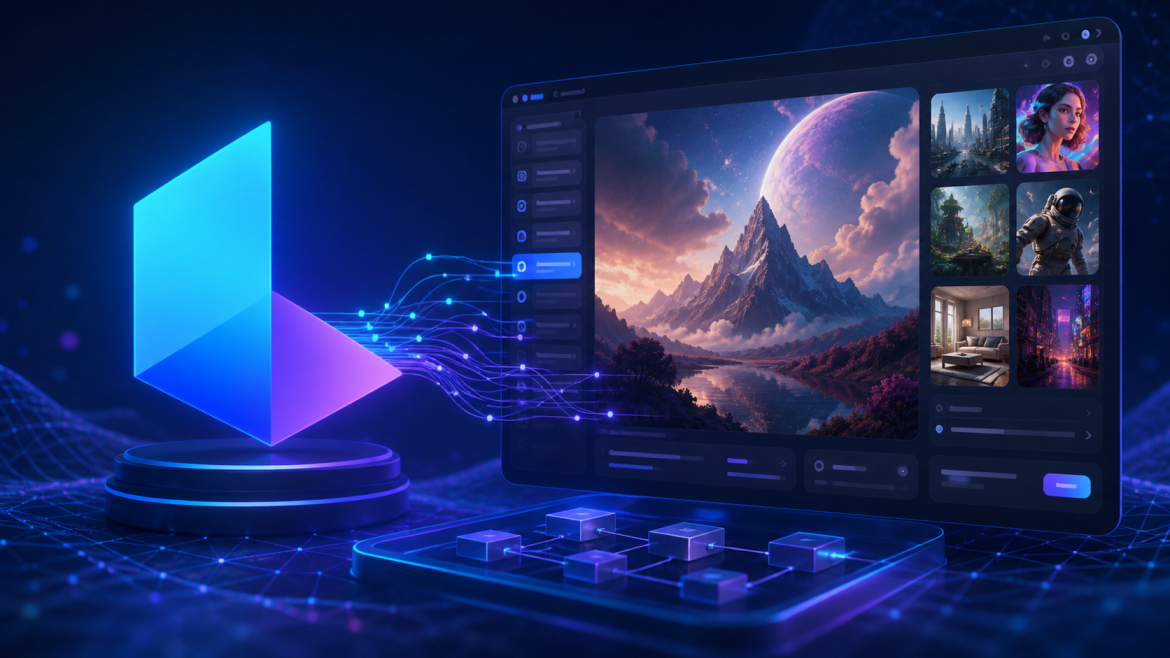
Luma AI has
officially launched the Uni-1.1 API, introducing a new image generation system
aimed at developers, creators, and businesses building AI-powered creative
tools. The release marks another major step in the rapidly evolving generative
AI sector, where companies are competing to deliver faster, more accurate, and
more controllable visual generation models.
The Uni-1.1
API became available on May 5 and is designed to allow direct integration of
Luma AI’s image generation capabilities into applications, creative platforms,
and automated workflows.
Focus on
Reasoning-Based Image Generation
Unlike many
conventional image generation systems that interpret prompts in a single pass,
Uni-1.1 is built around a transformer-based architecture designed to process
prompts through a more structured reasoning approach.
According to
Luma AI, the model breaks down instructions step-by-step before generating
outputs, improving its ability to understand complex requests and maintain
consistency across edits and multiple images.
This
approach is intended to address one of the biggest limitations in current AI
image generation systems: difficulty handling layered instructions and
maintaining visual continuity.
Industry
analysts note that reasoning-driven models are becoming an increasingly
important direction in AI development, particularly as users demand more
precision and control over generated content.
Multi-Image
Consistency Becomes Key Feature
One of the
most discussed capabilities of Uni-1.1 is its support for multi-image
consistency.
Maintaining
consistent characters, objects, and visual styles across several generated
images has traditionally been a challenge for AI systems. Luma AI claims the
new model improves continuity, making it more suitable for workflows involving
storytelling, branding, design systems, and sequential content creation.
The feature
is expected to appeal to creators producing comics, animation concepts,
marketing visuals, and product mockups where consistency is essential.
Natural-Language
Editing Expands Workflow Control
The API also
introduces expanded natural-language editing functionality.
Developers
and creators can reportedly make detailed visual adjustments using
conversational instructions instead of relying on technical editing tools or
repeated prompt experimentation.
This
capability reflects a broader trend within generative AI, where companies are
attempting to simplify creative workflows by reducing the need for manual
editing and technical complexity.
Analysts
suggest that natural-language-driven workflows could significantly reduce
production time for design-heavy projects.
Speed and
Cost Positioning
Luma AI is
positioning Uni-1.1 as both faster and more cost-efficient than competing image
generation systems.
The company
states that the API delivers image outputs at reduced operational cost while
maintaining high-quality generation performance. Lower inference costs are
becoming increasingly important in the AI industry, where infrastructure
expenses remain one of the biggest barriers to large-scale deployment.
Cost
efficiency is particularly important for startups and platforms integrating AI
generation into consumer-facing applications at scale.
The
company’s positioning highlights growing competition among AI providers not
only on model quality but also on affordability and processing speed.
Early
Creator Adoption Gains Attention
Shortly
after launch, creators and developers began showcasing examples generated using
Uni-1.1 across social platforms and creative communities.
Demonstrations
included reimagined cartoon artwork, manga-style page generation, technical
diagram transformations, and stylized concept visuals.
Several
creators highlighted the model’s ability to follow detailed instructions while
preserving structure and visual coherence.
These early
demonstrations have contributed to growing interest around the API within the
design and developer ecosystem.
Integration
Into Creative Platforms
Luma AI
confirmed that the Uni-1.1 API is already being used within external creative
tools and platforms.
Companies
including Envato and Krea are reportedly integrating the model into their
workflows and creative systems.
The
integrations reflect increasing demand for AI-assisted production pipelines
across industries such as marketing, media, design, and digital publishing.
As more
platforms adopt generative AI systems, interoperability and workflow
integration are becoming major competitive advantages.
Minor
Technical Issues Reported
Despite
positive early feedback, some users reported minor dashboard-related glitches
following the rollout.
Most
concerns appear to involve interface responsiveness and account-level access
issues rather than problems with the core generation model itself.
Such issues
are relatively common during early-stage API launches, particularly when
adoption surges immediately after release.
Luma AI has
not indicated any major service disruptions linked to the launch.
Competition
Intensifies in AI Image Market
The release
of Uni-1.1 comes amid intensifying competition in the generative AI image
sector.
Technology
companies and startups are rapidly expanding capabilities in image, video, and
multimodal AI systems as demand for creative automation grows.
The market
is increasingly shifting toward models that combine generation quality with
workflow practicality, consistency, editing precision, and scalability.
Industry
experts suggest that future competition will depend not only on visual realism
but also on how effectively AI systems integrate into real-world production
environments.
Outlook
The launch
of Uni-1.1 reflects the broader evolution of AI image generation from
experimental novelty to production-focused infrastructure.
As creators
and businesses demand greater reliability, speed, and controllability,
reasoning-based systems like Uni-1.1 may influence the next phase of
development in generative AI tools.
The growing
emphasis on workflow integration, consistency, and natural-language control
signals a shift toward AI systems designed for practical creative operations
rather than standalone experimentation alone.
With adoption expanding across creative platforms and developer ecosystems, competition in the AI image generation industry is expected to accelerate further in the coming months.

.jpg)

Comments
Loading comments...
Leave a Comment