
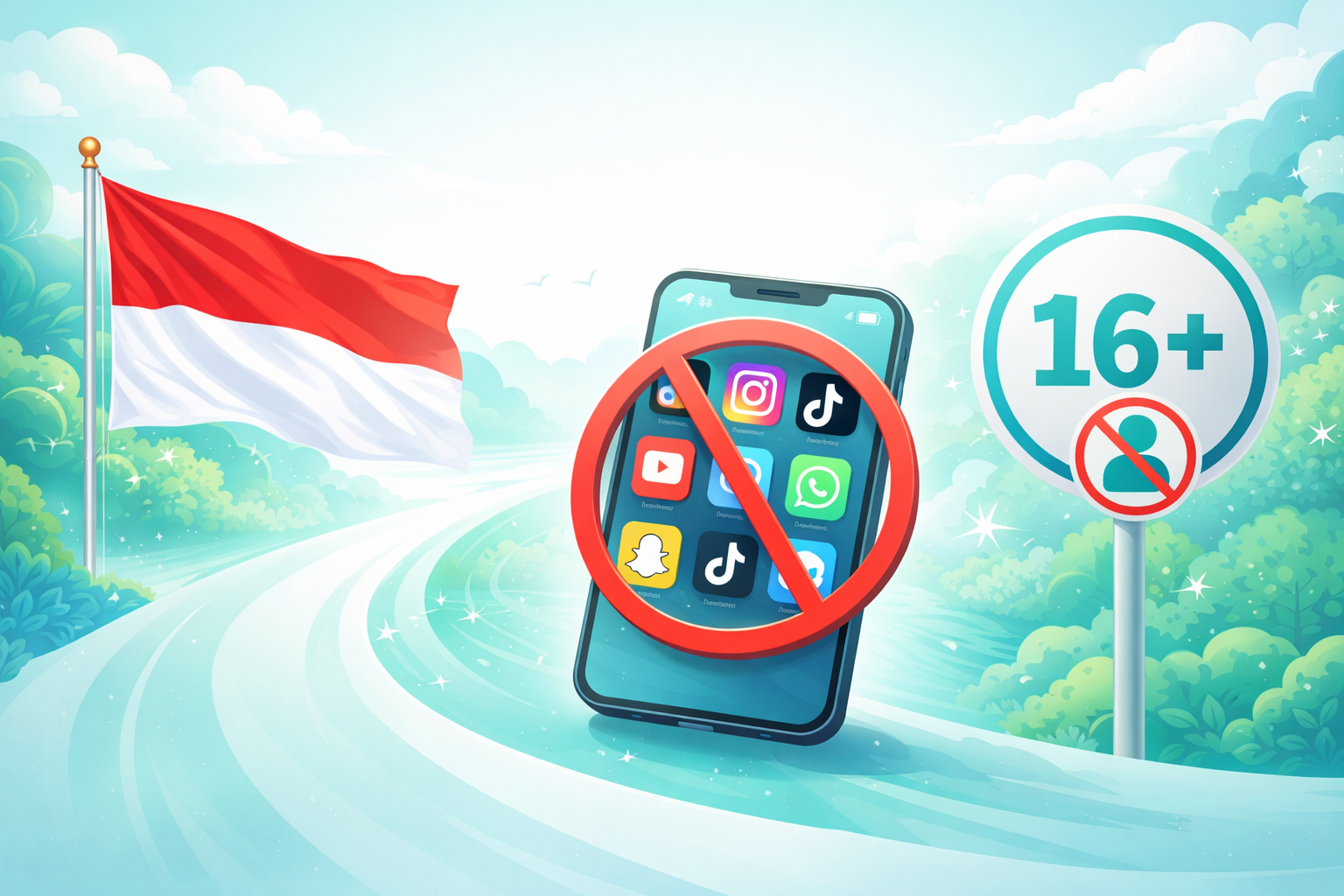
Indonesia’s
government has announced plans to restrict access to major social media
platforms for children under the age of 16, marking one of the most sweeping
efforts in Asia to limit minors’ exposure to online risks. The policy,
introduced by Communications and Digital Affairs Minister Meutya Hafid, will
begin rolling out on March 28, with authorities planning a gradual
deactivation of underage accounts on platforms considered high-risk.
The
regulation is intended to protect young users from online harms such as
pornography, cyberbullying, scams and digital addiction, concerns that have
increasingly drawn attention from policymakers around the world.
Accounts
to Be Gradually Deactivated
Under the
new policy, social media accounts belonging to children younger than 16 will
begin to be disabled over time as platforms comply with the government’s
requirements. Officials have identified several widely used platforms as
falling under the regulation, including TikTok, Facebook, Instagram,
YouTube, X, Threads, Bigo Live and Roblox.
The
government said the process would not happen all at once but would be
implemented gradually while technology companies adapt their systems to enforce
the age restriction.
Authorities
have not yet disclosed the full technical details of how the rule will be
implemented or how platforms will verify the ages of users. However, officials
indicated that social media companies will be required to comply with new
regulatory obligations under the ministry’s directive.
Government
Cites Safety Concerns
Minister
Hafid said the decision was driven by growing risks facing children in digital
environments, including exposure to harmful content and the psychological
effects of excessive social media use.
According to
the ministry, children are increasingly vulnerable to problems such as online
harassment, fraud schemes and addictive algorithm-driven content, prompting
the government to intervene.
Officials
also acknowledged that the transition may cause confusion for families and
resistance among young users, particularly during the early phase of
implementation. Nevertheless, the government maintains that stronger safeguards
are necessary as social media becomes a central part of children’s daily lives.
Indonesia
Among Countries Tightening Youth Online Access
Indonesia’s
move reflects a broader global trend toward stricter regulation of children’s
social media access. Governments in several countries have recently proposed or
introduced measures to limit the use of major platforms by minors due to
concerns over mental health, online safety and digital addiction.
Australia
became the first country to introduce a nationwide ban on social media access
for children under 16 in late 2025, while several European nations have
considered similar restrictions or implemented partial limits for younger
users.
Indonesia’s
policy makes it one of the first major countries in Asia to pursue such a broad
restriction on youth access to social platforms.
A Large
Youth Population Online
The policy
is likely to affect millions of young users. Indonesia, home to more than 280
million people, has one of the world’s fastest-growing internet
populations. Internet penetration reached nearly 80 percent in 2024,
according to surveys cited by government officials.
Research has
also shown that many Indonesian children gain internet access at an early age.
Surveys indicate that a significant portion of children under 12 already use
online services, including social media platforms.
Because of
this rapid growth in youth connectivity, policymakers have increasingly
expressed concern about how online platforms influence children’s behaviour and
wellbeing.
Mixed
Public Reaction
The
government’s announcement has triggered debate among parents, educators and
digital rights advocates. Some parents have welcomed the restrictions, arguing
that young users are often exposed to inappropriate material or harmful online
interactions at an early age.
Supporters
say the policy could help reduce children’s exposure to harassment, misleading
content and addictive platform features designed to maximize screen time.
However,
critics warn that such measures could raise questions about enforcement and
parental responsibility. Some analysts have suggested that governments should
prioritize digital literacy and stronger parental controls rather than imposing
broad restrictions on youth access to social platforms.
Technology
Companies Yet to Respond
Major
technology companies affected by the policy have not yet issued detailed public
responses regarding how they plan to implement the new rules. Platforms such as
TikTok, Meta (which owns Facebook and Instagram) and Roblox are expected to
work with Indonesian authorities as the regulation takes effect.
The extent
to which these companies will need to adjust their age-verification systems or
platform policies remains unclear.
Implementation
and Future Impact
The
Indonesian government has stated that enforcement will begin gradually from
late March while regulators work with digital platforms to ensure compliance.
While the
full impact of the policy will depend on how it is implemented, the move
signals a growing willingness among governments to intervene in the digital
lives of younger users.
As concerns
about children’s online safety continue to grow globally, Indonesia’s decision
may add momentum to ongoing debates about whether stricter age limits should
apply to social media use worldwide.
.jpg)

.jpg)
.jpg)

Comments
Loading comments...
Leave a Comment